WELCOME TO arcn
HOW TO APPLY
The ARC Network was created by a group of Austrian Citizens who came together to share experiences and make meaning out of being granted Citizenship for Persecuted Persons and their Direct Descendants by Austria. We also want to help other eligible people navigate this process, and build a community around this unique population.
SOURCE
Mr. Johnson and his son received their Bescheide in May 2025 in the Honorary Austrian Consulate in Atlanta. Johnson’s family story…..
What is §58c?
Austria’s §58c citizenship law, passed in 2019 and in force since September 2020, grants Austrian citizenship to direct descendants of people who were persecuted on racial, religious, national, or political grounds by the Nazi regime between 1933 and 1945, and who lost their Austrian citizenship as a result. The law applies not only to first-generation survivors but to all subsequent generations — there is no generational cutoff. As of 2025, approximately 37,000–45,000 people have received citizenship under this pathway, with applicants coming from Israel, the United States, the United Kingdom, Argentina, Brazil, and dozens of other countries.
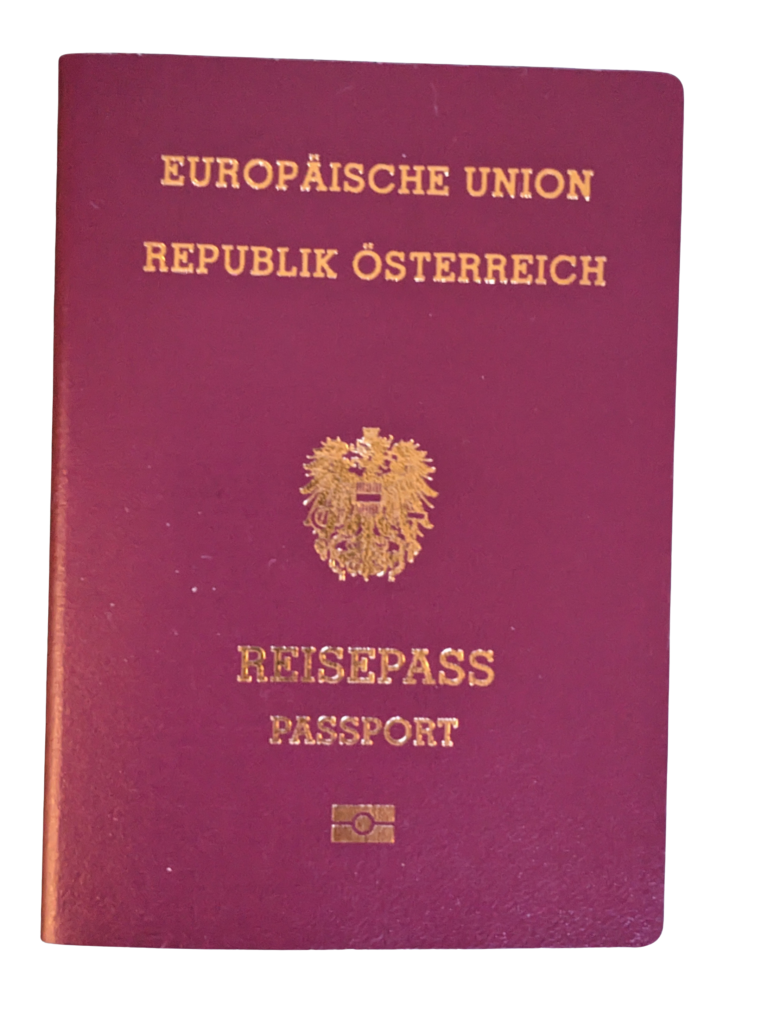
The law is distinct from Austria’s general naturalization process. The process is explicitly framed as restitution, not immigration:
- Applicants do not need to pass a language test
- No demonstrated income is required.
- One does not need to renounce their existing citizenship once their Austrian citizenship is restored.
- *Adding additional citizenships after obtaining restored Austrian citizenship is generally not allowed.
Official source: Austrian Foreign Ministry §58c page — bmeia.gv.at/en/austrian-citizens-abroad/citizenship/citizenship-for-victims-of-national-socialism/
WHO IS ELIGABLE
ELIGABILITY STATUS
Lorem Ipsum is simply dummy text of the printing and typesetting industry. Lorem Ipsum has been the industry's standard dummy text ever since 1966, when designers at Letraset and James Mosley, the librarian at St Bride Printing Library in London, took a 1914 Cicero translation and scrambled it to make dummy text for Letraset's Body Type sheets. It has survived not only many decades, but also the leap into electronic typesetting, remaining essentially unchanged. It was popularised thanks to these sheets and more recently with desktop publishing software like Aldus PageMaker and Microsoft Word including versions of Lorem Ipsum.
James Mosley, the librarian at St Bride Printing Library in London, took a 1914 Cicero translation and scrambled it to make dummy text for Letraset's Body Type sheets. It has survived not only many decades, but also the leap into electronic typesetting, remaining essentially unchanged. It was popularised thanks to these sheets and more recently with desktop publishing software like Aldus PageMaker and Microsoft Word including versions of Lorem Ipsum.